ISSUE 04
April 2026
Symposia Magazine
Te Whanganui-a-Tara
Online Edition
April 2026
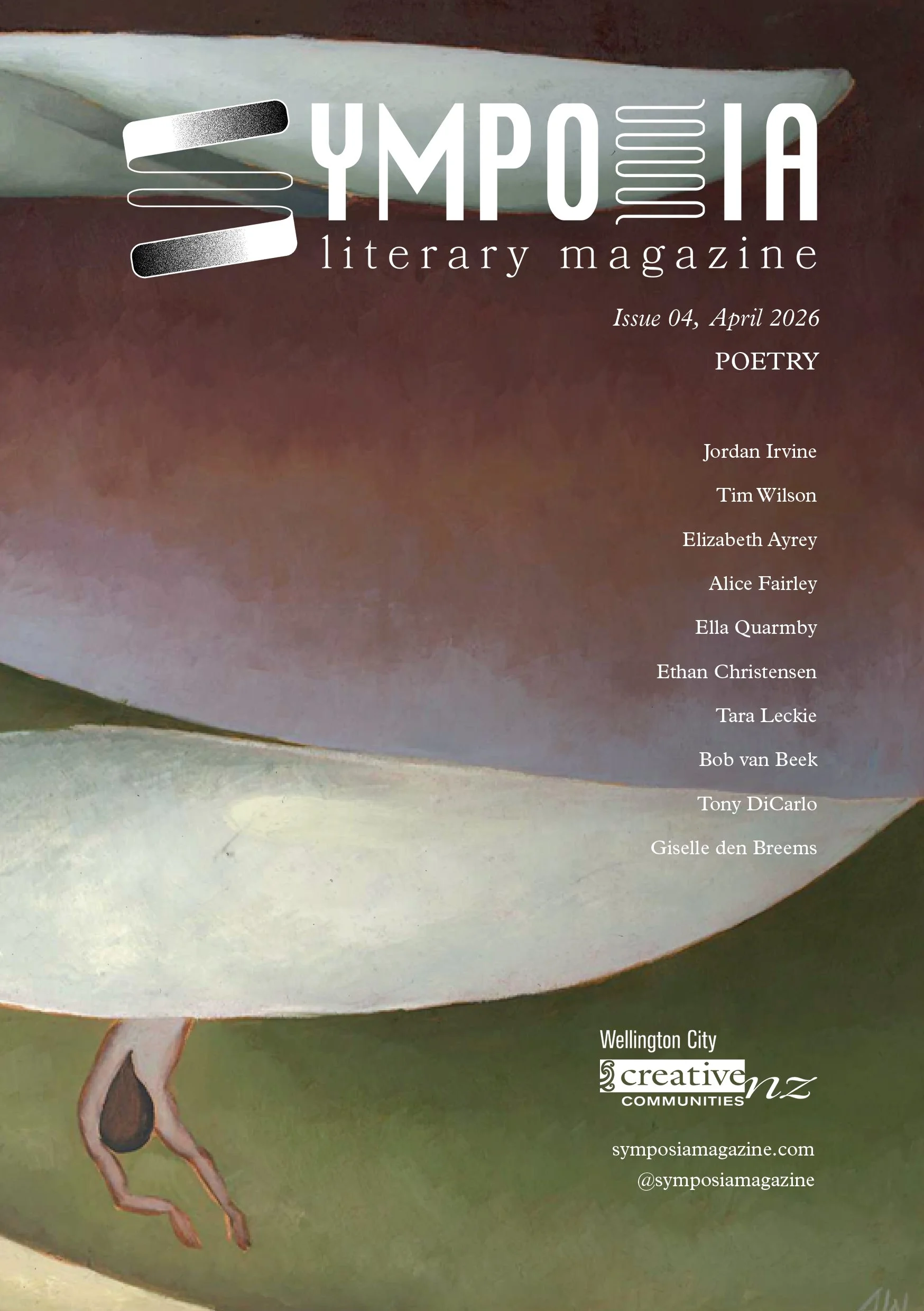
Cover Artist
Anneke Westra
Illustrator
Kata Brown
Editorial Team
Maia Armistead
Cadence Chung
Amelia Kirkness
Jackson McCarthy

With work by
Jordan Irvine
Tim Wilson
Elizabeth Ayrey
Alice Fairley
Ella Quarmby
Ethan Christensen
Tara Leckie
Bob van Beek
Tony DiCarlo
Giselle den Breems

Letter from the Editors
It feels like it was a long time ago that we sat down with a few friends with the gall and ambition of starting a literary magazine. From the start, we knew that Symposia’s concept would be lodged in these relationships, these friendships; and as we refined the magazine’s style over its now-four issues, we’ve learned what exactly that means: pairing a small number of quality poems with accompanying illustrations, cover art, and eloquent typography, bringing together visual and literary languages, assembling community on the page. In this, Kata Brown and Natasha Kerridge reprise their roles from Issue 3 as illustrator and designer, respectively, and Anneke Westra provides stunning cover art, creating a visual look that lets the poems shine only because it is itself so thoughtfully polished. We editors remain grateful for all these visual artists bring to our magazine. (And, as an aside, it’s been a real thrill to see these visual and literary worlds collide IRL, too — Cadence’s curated Salon series adds music to the mix in poetry/performance nights that began in early 2025. More to come later this year!)
Some things remain constant while others change: we are so pleased to present in Issue 4 a number of voices new to the pages of Symposia, alongside familiar faces. This issue has range — from the flowing, conversational sprawl of Elizabeth Ayrey’s ‘In Which the Longfin Eels Lament My Lesbian Situationship’ to the curt, lightly surreal pulse of Jordan Irvine’s ‘tall buildings’, all the way to the montage-monologue-essay-poem hybrid form of Ethan Christensen’s ‘What Do You Want?’ Like Christensen’s titular refrain, these poets are asking questions, and then sketching out that particular gap — the moment in which ideas are held in superposition — before an answer arrives with a thud. Some of these poets overwhelm us with language, as in Tim Wilson’s rollicking, riffing ‘Error 404’, in which a prayer becomes corrupted by the demeaning demands of working life. Others ‘[knock] off work’ and turn back to a kind of purity of speech, as in Bob van Beek’s formal delight ‘My Poem About Love’. Across his two poems, Tony DiCarlo’s twin visions have it both — both the consumer’s frenzy and the miniaturist’s touch — but it’s the clipped, quiet tones of the perfectly understated ‘Slow Dance Eulogies’ that bring things to a point: ‘If I told you / of the sorrow / it would matter / very much.’
Well, these poets are sad because our times are sad; these poets ascribe illness, situationships, faltering or missed connections, and glitches to a world that is ill, conditional, awash with disembodied voices, and malfunctioning. But these poets are also funny, in love, nostalgic, and open-hearted because our world is all of those things, too — it has to be, because we live in it. Ella Quarmby is the poet who both wants to ‘spit back / on all the things you still say’ to someone who has left us and yet must admit ‘I think you have made me’. These poets, this range, and more in Issue 4: we hope that this issue stands in all its contradiction spectacularly alive.
Our thanks are again and always to the Wellington City Council Creative Communities fund for their support of our mahi.
Maia, Cadence, Amelia, and Jackson
Our Contributors
Jordan Irvine (they/them) is an Ōtepoti born and Ōtautahi based poet. They have been featured in The Spinoff and bad apple.
Tara Leckie (she/her) writes poetry and short stories. She is currently based in Te Whanganui-a-Tara and likes spending time in wetlands.
At parties, Tim Wilson shuffles around murmuring, ‘Death to Prose, Death to Prose, Death to Prose.’ And he wonders why no-one talks to him.
Elizabeth Ayrey (she/her, Pākehā) was born in Ōtautahi and now writes from Ōtepoti, where she is undertaking a BASc in Marine Science and Indigenous Studies. Her work also appears in journals including Tarot, fingers comma toes, and The MAP. She was a 2021 winner of the NZ Poetry Society’s International Competition.
Alice Fairley (she/her) is a poet and novelist based in Whangārei. Her poetry has been included in publications such as Australian Poetry Journal, Tarot, and Turbine | Kapohau, among others. Recently, she published her first novel, Yellow Flower.
Ella Quarmby (she/her) studies English Literature at Victoria University of Wellington and is originally from the Bay of Plenty. You can find her poems in Poetry Aotearoa Yearbook, Mayhem, Tarot, and bad apple. You can also find her paintings in a fine line.
Ethan Christensen (he/him) is a writer from Coromandel Town, based currently in Tāmaki Makaurau. His work features in publications across Aotearoa and Australia, and, in 2025, he won the Peter Wells Short Fiction Most Promising Young Writer award, presented by samesame but different. In the breaths of community and belonging, he hopes others can see themselves in the experiences he puts to page, whatever they may be.
Bob van Beek (he/him) reads incessantly and sometimes writes his own things too. He recently graduated from Victoria University of Wellington with a BA in English literature and psychology, and currently resides nestlike in the peaceful, valleyed bosom of Upper Hutt.
Giselle den Breems (she/her) grew up in Auckland and began writing poems at age six, a year that saw highlights in ‘The Cloud Bird’ and ‘Spring Rain’. Now she lives in Wellington, studying psychology, philosophy, and French, and writing much sadder poems. Some of these can be found in Starling and previous issues of Symposia.
Tony DiCarlo (he/him) is a poet and translator from Northern California, currently residing in Wellington, New Zealand. His work has appeared previously in Capgras, Sweet Mammalian, and HAD, among others. Non-poetry aspirations include writing an essay called ‘Warcraft 3 and the Permanent Efficacy of Grace’ and eating a lot of KC Cafe.
Acknowledgements
We would like to thank the Wellington City Council Creative Communities Scheme for supporting our magazine. We would also like to thank our donors for their generous support, which will help us keep creating issues. We’re grateful to Anna Jackson, Rebecca Hawkes, and Francis Cooke for their editorial insights, as well as to everyone who has shared, supported, and submitted to Symposia Magazine.

